
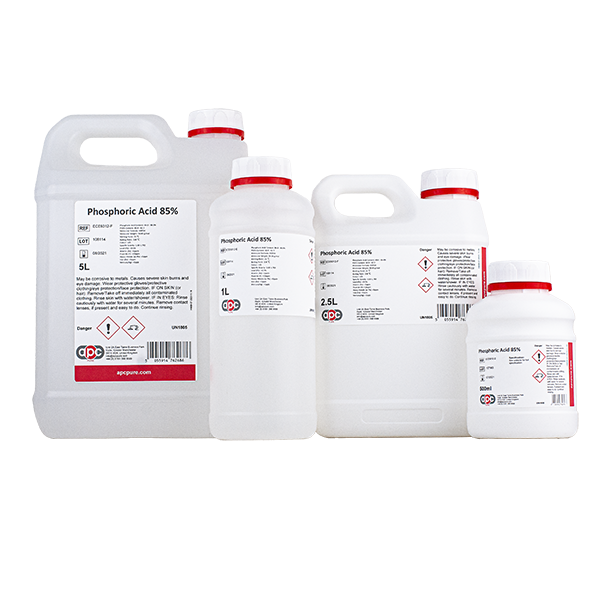
Description
Product Specifications
| Property | Specification |
|---|---|
| Chemical Name | Phosphoric Acid |
| Chemical Formula | H₃PO₄ |
| CAS Number | 7664-38-2 |
| Appearance | Clear to slightly yellow viscous liquid |
| Molecular Weight | 98.00 g/mol |
| Purity | Typically 75%–85% (Industrial Grade varies) |
| pH | < 1 (strongly acidic) |
| Density | ~1.50–1.70 g/cm³ (depending on concentration) |
| Solubility | Completely miscible with water |
| Packaging | 25 L containers, 200 L drums, 1,000 L IBC tanks, bulk supply |
| Storage | Store in corrosion-resistant containers in a cool, dry, well-ventilated area away from bases and incompatible materials. |
Uses
Phosphoric Acid is widely used across several industries, including:
- Fertilizer production (primary raw material for phosphate fertilizers).
- Water treatment for pH adjustment and scale control.
- Metal surface treatment and rust removal.
- Industrial cleaning and descaling applications.
- Food and beverage acidulant (food-grade applications only).
- Detergent and cleaning product manufacturing.
- Chemical synthesis and manufacturing processes.
- Textile and dyeing industry applications.
- Pharmaceutical and laboratory reagent use.
- Oil and gas industry for well stimulation and cleaning.
Benefits
- Excellent pH control and acidification properties.
- Highly effective in rust removal and metal treatment.
- Essential raw material for agricultural fertilizers.
- Improves efficiency in industrial cleaning processes.
- Versatile across multiple industrial sectors.
- Stable and reliable under proper storage conditions.
- Compatible with a wide range of chemical formulations.
- Cost-effective solution for large-scale industrial use.
- Supports improved water quality management.
- Widely recognized and globally utilized chemical.
Safety Information
- Corrosive material. Causes severe burns to skin and eyes.
- Wear appropriate PPE including gloves, goggles, face shield, and protective clothing.
- Avoid direct contact with skin, eyes, and clothing.
- Use only in well-ventilated areas to avoid mist exposure.
- Store in corrosion-resistant containers away from bases, oxidizers, and reactive metals.
- In case of eye contact, rinse immediately with plenty of water and seek urgent medical attention.
- In case of skin contact, wash immediately with water and remove contaminated clothing.
- If inhaled, move to fresh air and seek medical attention if symptoms occur.
- In case of spills, contain and neutralize according to safety procedures.
- Always consult the latest Safety Data Sheet (SDS) before handling, storage, or transport.

Reviews
There are no reviews yet.